
Photochromic Film

APPLICATIONS
Airport | Apartment | Cafe | Conference room | Contractor | Convention Hall | Department store | Home | Hotel | Mall | Museum | Office | Pool | Religious center | Resort | Restaurant | Shops | SOHO | Studio workshop | Supermarket | Training center
SERVICES
COVERAGE
PARTNERS
PStatic glass limits how spaces adapt to changing light. Traditional windows and glass partitions trap excess solar heat, generate harsh glare, and force a reliance on motorized blinds or permanent dark tints that obscure views during overcast weather. This rigidity leads to spiked HVAC energy costs, uncomfortable glare for occupants, and inflexible spaces that cannot balance daylight with thermal comfort.
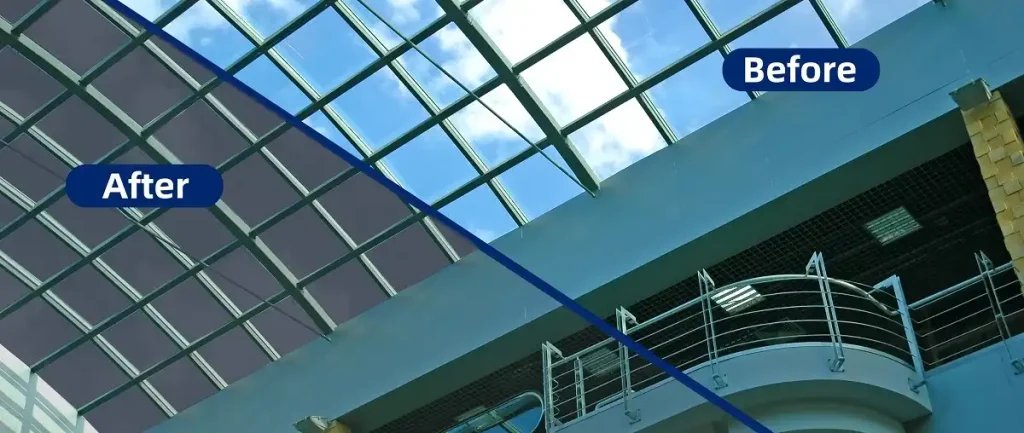
A Photochromic Film solves this dynamic challenge by automatically adjusting its tint density in direct response to sunlight intensity, turning standard glass into self-regulating adaptive architecture.
The Molecular Science at Work
Applied directly to existing or new glass surfaces, photochromic film utilizes embedded nano-structured molecular compounds that react autonomously to ultraviolet (UV) radiation. Unlike powered electrochromic glass, this system functions continuously without electrical wiring, transformers, or manual controls.
As solar radiation shifts throughout the day, the film executes an instant chemical adaptation:
- Autonomous UV Activation: Solar UV rays excite embedded micro-molecules, causing them to change structure and naturally darken to block excess light.
- Seamless Dynamic Reversion: As daylight fades or cloud cover moves in, the molecules return to their clear ground state, maximizing natural daylight intake.
- Broad-Spectrum Heat Rejection: Blocks up to 99% of damaging UV rays and a high percentage of Infrared (IR) heat across both clear and tinted states.
- Zero-Power Operational Profile: Operates entirely passively, eliminating energy consumption, control wiring, and mechanical maintenance points.
What Occupants Experience
By continuously balancing indoor illumination and solar energy transfer, adaptive film fundamentally improves how people experience a building.
- Effortless Visual Comfort: Eliminates blinding glare on digital screens and work surfaces without the need to pull blinds or turn on overhead lights.
- Continuous Exterior Views: Maintains clear connection to the outdoor environment by replacing opaque window coverings with self-adjusting tinting.
- UV & Thermal Shielding: Prevents interior furniture, flooring, and displays from sun fading while keeping indoor temperatures consistent.
Prime Spatial Deployments
Smart photochromic film integrates smoothly into architectural and commercial projects seeking intelligent envelope optimization:
- Commercial Office Towers: Applied to curtain walls, skylights, and executive suites to reduce cooling loads and stabilize perimeter workspace temperatures.
- Retail & Automobile Showrooms: Protects merchandise from solar fade while preserving daylight transparency for passersby.
- Luxury Residential & Hospitality: Enhances guest comfort across sunrooms, glass facades, and oceanfront suites without obstructing views.
- Transportation & Automotive: Applied to sunroofs and vehicle side windows for dynamic glare control while driving.
Why Integrate Adaptive Film into Your Project?
For system integrators, facade consultants, and spatial designers, embedding a Photochromic Film module introduces immediate sustainability value to any structural design. It transforms passive glass into an active thermal barrier, significantly lowering HVAC loads and helping projects meet strict green building standards.
By offering dynamic tinting as a seamless sub-system, you give clients a zero-maintenance, energy-efficient solution that elevates occupant comfort while lowering operational costs over the lifetime of the building.