
Haptic System
APPLICATIONS
SERVICES
COVERAGE
DEPARTMENT
PARTNERS
Visual and auditory cues can only take virtual experiences so far. In traditional digital environments, users remain detached spectators—looking at a screen or through a headset, yet feeling nothing of the simulated world around them. When a virtual object is touched, a recoil is fired, or a physical impact occurs in a simulation, the lack of tactile feedback breaks immersion instantly. This sensory disconnect limits the realism required for high-stakes training, immersive entertainment, and hyper-realistic digital twin environments.
A Haptic System bridges this gap by introducing the missing sense of touch, transforming passive digital observation into full-body physical presence.
Anatomy of Digital Touch
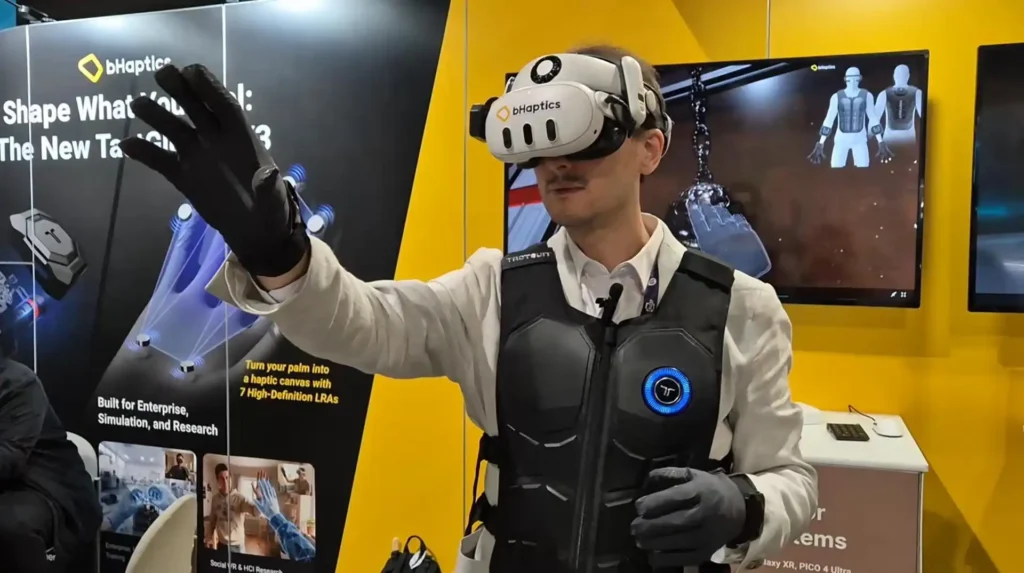
At the core of tactile immersion is a synchronized matrix of miniature actuators distributed across wearable gear like vests, gloves, sleeves, or headbands. Rather than relying on simple vibration motors, advanced tactile architectures utilize multi-frequency eccentric rotating mass (ERM) motors, linear resonant actuators (LRAs), or voice coil actuators (VCAs) to replicate complex physical sensations.
Driven by precise spatial algorithms, the system translates real-time telemetry from virtual environments into distinct tactile waveforms:
- Targeted Spatial Actuation: Dozens of independently controlled feedback points pinpoint exact impact coordinates across the chest, back, arms, or hands.
- Dynamic Waveform Synthesis: Modulates frequency, amplitude, and duration to simulate diverse textures—from the light pitter-patter of rain and delicate pulse of a heartbeat to the heavy thud of a physical collision.
- Low-Latency Wireless Control: High-speed wireless protocols ensure sub-millisecond synchronization between visual events in the headset and physical sensations on the body.
- Ergonomic Wearable Matrix: Breathable, adjustable physical housings engineered for quick donning, long operational wear, and easy sanitation in high-throughput environments.
What the User Feels
By engaging the human somatosensory system, wearable tactile feedback changes how users perceive and react within digital environments.
- Genuine Spatial Presence: Converts visual effects into visceral physical feedback, tricking the brain into accepting the virtual world as tangible reality.
- Enhanced Muscle Memory & Reflexes: Accelerates skill acquisition by providing immediate physical confirmation during procedural tasks, tool handling, or target practice.
- Intuitive Situational Awareness: Allows users to feel directional cues—such as footsteps from behind or environmental hazards—without relying solely on line of sight.
Environments Transformed by Touch
Tactile feedback hardware elevates any immersive application where realism directly impacts performance and engagement:
- Defense & Emergency Response Training: Replicates recoil, physical hazards, and stress conditions for tactical scenarios, firefighting, and flight simulation.
- Medical & Surgical Simulation: Delivers tactile resistance and tissue feedback to help surgeons and medical trainees practice delicate procedures without patient risk.
- Location-Based VR & Entertainment Hubs: Powers full-body immersion in escape rooms, arcade arenas, and theme park attractions to deliver unmatched guest experiences.
- Industrial Design & Digital Twins: Enables engineers and designers to physically "feel" ergonomic CAD models, virtual controls, and simulated assembly lines.
Unlocking the Next Dimension in Your Architecture
For solution integrators crafting next-generation VR platforms or simulation environments, adding tactile feedback turns a standard display setup into a complete sensory ecosystem. It provides the crucial physical layer that unifies visual tracking, spatial audio, and user input into a cohesive reality.
By integrating a flexible haptic module into your overarching project framework, you empower your clients to offer deeply memorable, hyper-realistic experiences that build true muscle memory, heighten user engagement, and set a new standard for spatial computing.


