
Virtual Reality (VR) System
APPLICATIONS
SERVICES
COVERAGE
DEPARTMENT
PARTNERS
Traditional training environments, physical showrooms, and standard flat-screen displays often fall short when attempting to convey complex 3D spatial concepts or high-stakes operational scenarios. Physical prototypes are expensive to build and transport, while simulated real-world training carries safety risks and significant logistical overhead. Without a fully immersive medium, organizations face high operational costs, longer learning curves, and limited engagement in remote or simulated environments.
A Virtual Reality System overcomes these physical boundaries by generating interactive, 360-degree digital environments that place users directly inside simulated scenarios with complete spatial awareness.
Hardware Architecture & Tracking Technology
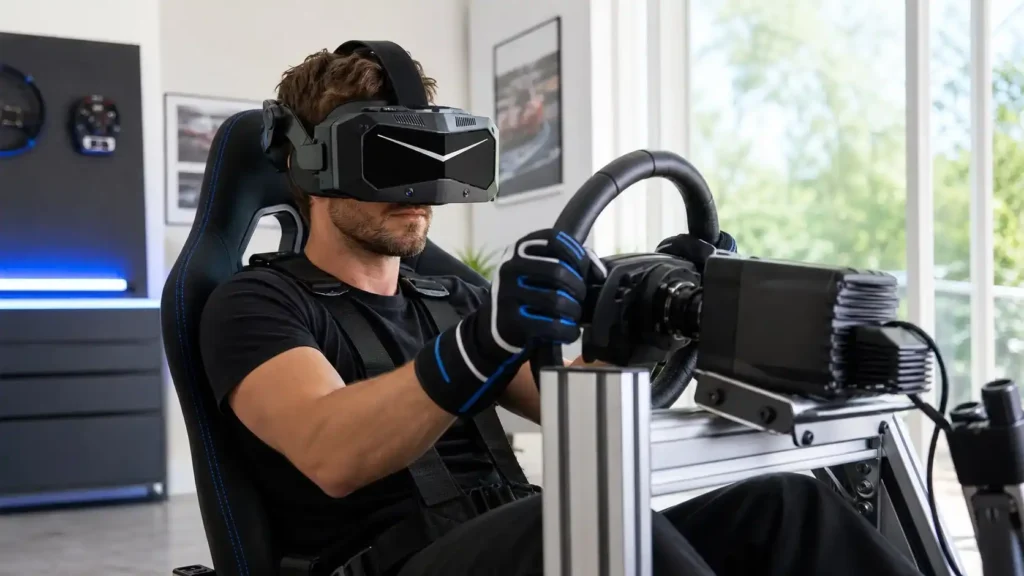
Modern enterprise virtual reality relies on ultra-high-resolution optics, sub-millimeter positional tracking, and real-time spatial computing. Built to handle complex graphics rendering, the hardware delivers fluid, motion-to-photon synchronization to maintain visual realism:
- High-Density Optical Displays: Industrial-grade headsets featuring dual 4K micro-OLED displays, wide field-of-view lenses, and high refresh rates to eliminate visual screen-door effects and motion discomfort.
- Precision Spatial Tracking: Inside-out camera arrays and external lighthouse sensors providing six-degrees-of-freedom (6DoF) position monitoring for accurate head and hand movements.
- Haptic Interfaces & Controllers: Ergonomic input devices and force-feedback haptic gloves that simulate tactile resistance, surface textures, and physical object interaction.
- Enterprise Render Nodes: High-performance local workstations or cloud-edge GPU clusters optimized for low-latency graphics processing and multi-user networking.
User Immersion & Cognitive Impact
Placing users within interactive spatial environments redefines how individuals learn, collaborate, and evaluate complex designs.
- Total Environmental Immersion: Isolates external visual and acoustic distractions, driving maximum focus and deep cognitive engagement during critical tasks.
- Risk-Free Scenario Simulation: Allows personnel to rehearse dangerous industrial procedures, emergency protocols, or surgical operations without real-world consequences.
- Accelerated Spatial Comprehension: Enables stakeholders to walk through unbuilt architectural designs, inspect 1:1 scale machinery, and spot design flaws before physical construction begins.
Target Deployment Sectors
Spatial simulation platforms integrate effectively across high-value commercial, educational, and technical environments:
- Industrial Manufacturing & Engineering: Facilitates collaborative 3D CAD design reviews, digital twin assembly testing, and remote factory line walkthroughs.
- Healthcare & Flight Training: Powers realistic clinical skill simulations, anatomical explorations, and high-g flight maneuvers for specialized personnel.
- Commercial Real Estate & Retail: Offers virtual property tours for overseas buyers and interactive retail store layout testing prior to physical build-outs.
Commercial ROI & Technological Advantage
For system integrators, corporate innovators, and facility architects, a virtual reality deployment acts as an active catalyst for operational efficiency. It drastically reduces capital expenditure spent on physical prototyping, travel, and material waste while accelerating time-to-market for complex products.
By incorporating a dedicated VR simulation framework into your client solutions, you provide organizations with a future-ready visualization engine that scales safety, elevates training retention, and unlocks new dimensions of digital collaboration.