AV-over-IP (Audio-Visual over Internet Protocol) is transforming the way audio and video signals are transmitted over IP networks. This technology supports the distribution of high-quality audio and video content over long distances with minimal latency. With advancements in network technology and the availability of affordable hardware, AV-over-IP is rapidly gaining popularity. Let’s explore its key benefits and applications.
-
Key Benefits of AV-over-IP Technology
1. Scalability
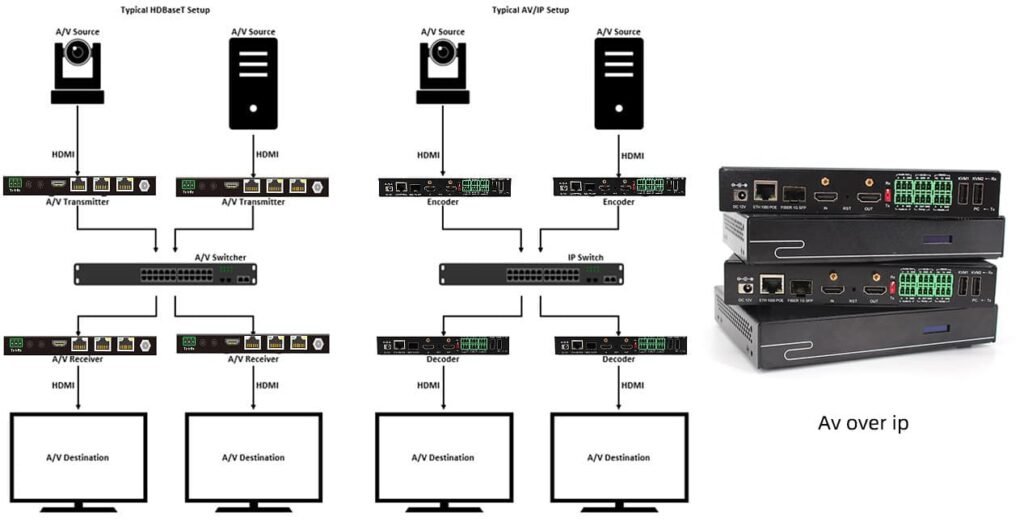
AV-over-IP technology excels in scalability, making it easy to manage numerous audio and video sources and destinations. Unlike traditional point-to-point AV systems, AV-over-IP uses network switches to route signals, allowing for seamless expansion. Adding new sources or displays is straightforward, eliminating the need for complex rewiring or infrastructure changes.
2. Cost-Effectiveness
AV-over-IP is often more economical than traditional AV distribution systems, particularly for large installations. It reduces the need for extensive AV cabling, cutting costs on materials and labor. Additionally, standard IP networking components can replace specialized AV equipment, further reducing expenses.
3. Flexibility and Easy Installation
Leveraging existing IP network infrastructure, AV-over-IP simplifies integration with a facility’s IT systems. This integration reduces installation complexity by eliminating separate AV cabling, saving time and effort. It also enhances signal routing flexibility, allowing easy changes or reconfigurations without physical rewiring.
4. Centralized Management and Control
AV-over-IP facilitates centralized management, enabling administrators to configure, monitor, and control all AV devices from a single location. Utilizing network protocols and control software streamlines system management, simplifies troubleshooting, and boosts operational efficiency.
5. High-Quality and Low Latency
Using video compression standards like H.264 or H.265, AV-over-IP technologies deliver high-quality audio and video with minimal latency. This feature is essential for real-time interactions, such as videoconferencing, live events, or command and control centers, ensuring smooth and uninterrupted communication.
6. Seamless Integration with IT Infrastructure
AV-over-IP seamlessly integrates with existing IT networks, enabling the convergence of audio, video, and data on a single network. This integration simplifies maintenance and support, allowing IT staff to utilize their existing knowledge and tools. It also supports integration with other networked systems and services, such as remote monitoring, content management, or scheduling systems.
7. Remote Accessibility and Collaboration
AV-over-IP enhances remote accessibility to audio and video content, allowing users to control AV devices and access content from any network-connected location. This feature is invaluable for multi-site organizations, distributed teams, or remote workers needing to collaborate or access shared AV resources.
8. Future-Proof and Technology Compatible
Designed to be future-proof, AV-over-IP supports evolving IP network technologies. As IT networks advance, AV-over-IP systems can utilize higher bandwidth, improved security, and enhanced features without significant infrastructure modifications. This adaptability ensures long-term viability and compatibility with future technological advancements.
Applications of AV-over-IP Technology
AV-over-IP technology is widely used in various sectors, including:
- Corporate Environments: For seamless meetings, presentations, and collaboration.
- Education: Enhancing learning experiences with high-quality audio and video.
- Healthcare: Enabling remote consultations and monitoring with clear audio and video.
- Entertainment Venues: Providing reliable and high-quality AV content delivery.
As AV-over-IP technology continues to evolve, its adoption is expected to grow across different industries, offering enhanced audio-visual experiences and operational efficiencies.